Heavy Rain, Flooding, and Chance of Severe Weather Staring Down the Southern U.S.
January 22, 2024
Posted: April 1, 2022 11:48 am




Lake Mead, the largest manmade reservoir in the United States, has appeared in the news often in recent years because of a growing water crisis in the western areas of the country. Scientists use a variety of measurements related to the lake’s water levels to help them gauge existing and potential drought conditions. The numbers they’re seeing have filled them with dread about the future of sustainability and survivability for human populations and even wild flora and fauna in the West.
In the 1930s, representatives for Arizona, California, Colorado, New Mexico, Nevada, Utah and Wyoming agreed to use the Colorado River in a collaborative fashion. This agreement resulted in the creation of the Hoover Dam to provide water throughout the region for drinking, irrigation and electric power generation. Lake Mead is the name of the Hoover Dam reservoir created in September 1935 approximately 24 miles from Las Vegas.
The water for Lake Mead comes from more than the Colorado River, which primarily receives its water from melted snow found in Colorado, Utah and Wyoming. Inflow waters feed to Lake Mead from the Glen Canyon Dam. Federal law requires that the Glen Canyon Dam release at least 10,150,000 megaliters or 8.23 million acre-feet of water to Lake Mead every year.
From below Hoover Dam, Lake Mead must provide at least 11,000,000 megaliters or 9 million acre-feet of water to more than 25 million people a year in Arizona, California and Nevada and even parts of Mexico. Many large farms rely on the water as well. As of 2022, the current resident populations of some U.S. states are lower than the number of people who depend on Lake Mead for water.
Typical actual outflow demand ranges between 11,700,000 to 12,000,000 megaliters or 9.5 to 9.7 million acre-feet. Hoover Dam also uses Lake Mead’s water to power generators that supply electricity to Arizona, California and Nevada.
In addition, Hoover Dam and Lake Mead act as a major recreational and monument destination that brings in tourism-related revenues to the region from approximately 7 million visitors yearly. Locals and visitors use the lake and surrounding beaches, cliffs, coves and other venues for entertainment, including boating, fishing, swimming and water skiing. It even has a nearby botanical garden oriented toward celebrating the local plants and animals of the region.
When the lake is full, it’s approximately 112 miles long with a surface area of 247 square miles and a deepest depth of 532 feet. It rises 1,229 feet above sea level and holds 34,820,000 megaliters or 28.23 million acre-feet of water.
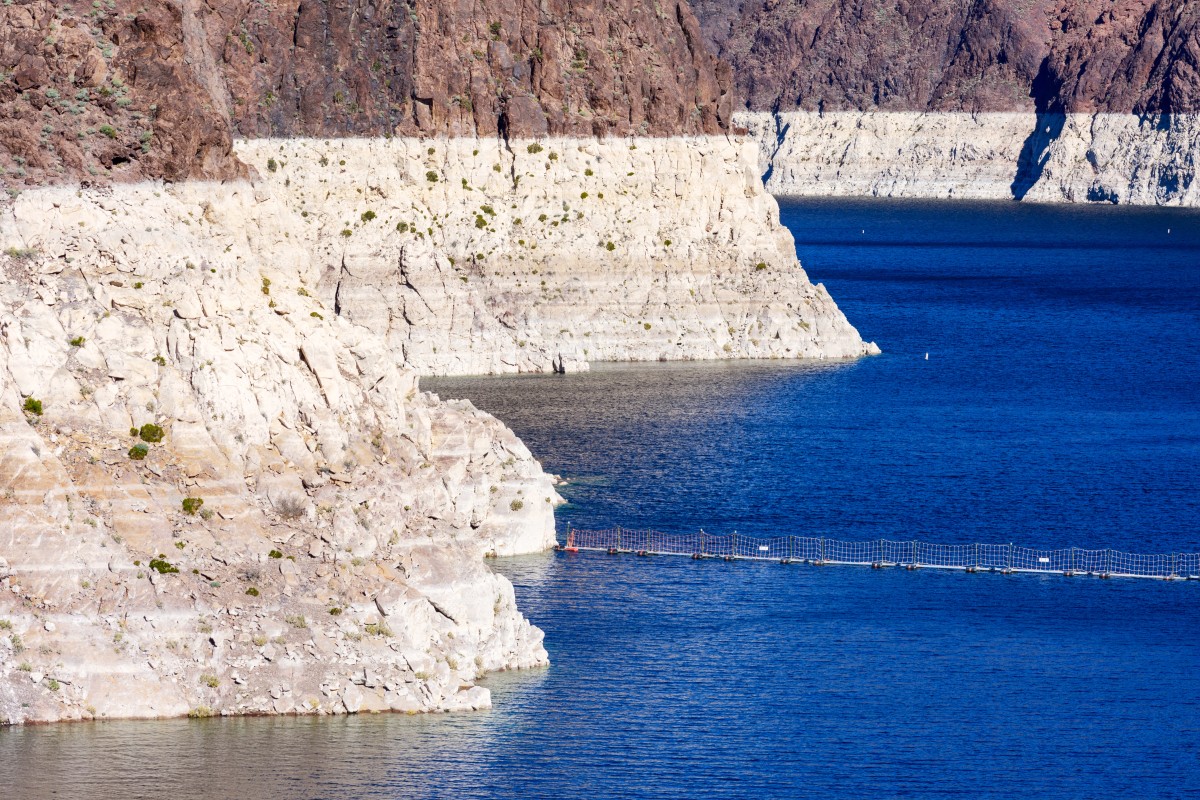
When water in the lake drops below recommended levels, the cliffs around it display a white ring from mineral deposits that form on them when they’re under the water. Scientists often reference this ring when discussing drought conditions in the region because it offers a clear picture of the impact of water loss.
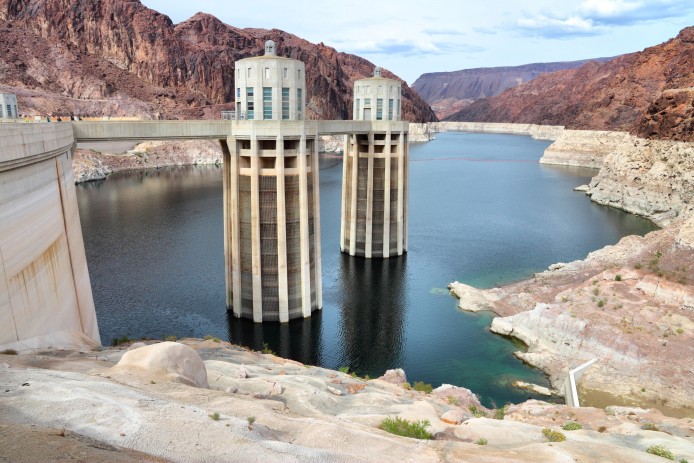
In 2000, scientists considered Lake Mead “full,” but the reservoir hasn’t actually reached its true full capacity since 1983 because of a combination of factors, including increased water demands from rapidly growing populations in downflow states, natural evaporation and droughts caused by climate change.
In the 1930s, hydrologists advised backers of the creation of Hoover Dam and Lake Mead that the Colorado River would eventually be unable to provide enough water for people in downflow areas as populations in reliant states grew.
Not only did populations grow beyond predicted levels, but scientists also discovered that Lake Mead naturally loses approximately 6 feet of water via evaporation yearly. Additionally, the year 2000 marked the beginning of one of the longest, driest, historic droughts in the region. Known as the Southwestern North American Megadrought, the drought has impacted many western states with conditions not seen since 800 AD.
Modern scientists believe that water shortages might have occurred even without the drought because of the demand on this precious resource by millions of people. The Colorado River simply can’t sustain increased population and agricultural fresh water demands from downflow areas.
Climate change has exacerbated this problem by preventing the formation of enough snowpacks to supply the same levels of water from snow melt to the river as in previous years, decades and centuries. Year-to-year increased temperatures also warm up the water enough to cause a high amount of evaporation. The 6 feet of yearly evaporated water equals approximately 300 billion gallons of water loss. During late spring and summer months, the river can lose approximately 10 billion gallons in a week from evaporation during a severe heat wave.
In June 2021, Lake Mead’s water levels fell 143 feet below the levels deemed equal to “full” in 2000. The lake was at only 36 percent of capacity and 1070.60 feet above sea level. In January 2022, a new measure of the lake found that the water levels dropped to 1,066.39 feet, which hasn’t happened since the 1937 fill date. In March 2022, a new measurement found Lake Mead at only 31 percent of capacity and 1,063.11 feet with only 10,797,000 megaliters or 8.753 million acre-feet of water in it.
The Bureau of Recreation (BOR) has predicted even greater water level drops for summer 2022. They have estimated water levels dropping to potentially 1,046.87 feet by the end of July. Hoover Dam’s power generation efficiency has already dropped by 25 percent from 2,000 megawatts of hydropower to 1,500 megawatts, which means that millions of people in Arizona, California and Nevada must endure brownouts and power outages. If Lake Mead loses too much water, Hoover Dam will stop working entirely. BOR has estimated that the lake must have a water levels of approximately 1,053 to 1075 feet for relatively stable power generation.
If the lake’s water levels hit 950 feet, Hoover Dam won’t work any longer at all. If this happens, people who rely on fresh water from Lake Mead will suffer, including farmers, ranchers and tribal communities. In Las Vegas alone, residents, businesses and visitors receive approximately 90 percent of their tap water from Lake Mead. Yet, intake structures within the lake haven’t performed well enough in recent years because of the lack of sufficient snow melt to supply fresh water.
Beyond power and tap water losses, further decline of Lake Mead will likely cause it to lose its status as a local and tourist destination for millions of people, which can only adversely impact local economies. Because of the drought, recreational areas have already changed drastically. Several ramps have closed, and shallow hull boats are the only vessels that can even work in certain areas.
Without a working hydroelectric dam, guided tours and exploration of the site by locals and visitors will dry up as much as the lake. Currently, state and federal government officials and scientists have yet to find a way to prevent additional future water-level drops at Lake Mead. They can only recommend that everyone use less water and recycle gray water whenever possible.

January 21, 2024
January 19, 2024
January 18, 2024